
Author

admin

Browsing

Travelers frustrated by long security lines may not see immediate relief, even as Transportation Security Administration officers begin receiving pay again on Monday after working without wages for more than a month during the partial government shutdown.

President Donald Trump signed an executive order Thursday directing federal officials to ensure that TSA workers are paid despite the shutdown, breaking a more than 40-day stretch in which officers went without salaries.

But the move is unlikely to bring instant relief at airport checkpoints, according to former TSA Administrator John S. Pistole.

“It’s a temporary fix,” he told NBC News.

The more pertinent question, he said, is how many workers actually return to their posts now that paychecks are set to resume Monday.

More than 500 officers have quit during the shutdown, according to the Department of Homeland Security, while thousands more have called out because they can’t afford basic expenses.

TSA callout rates reached a high of 12.35% of the workforce on Friday, accounting for more than 3,560 employees, a DHS spokesperson said Saturday. The department added that at Trump’s direction and under Homeland Security Secretary Markwayne Mullin, TSA has “immediately begun the process of paying its workforce” and that officers “should begin seeing paychecks as early as Monday, March 30.”

Those shortages have forced travelers to contend with missed and canceled flights, long security lines and growing uncertainty around air travel.

If most officers report back beginning Monday and airports are able to restore staffing, wait times could start to ease within several days to a couple of weeks, Pistole said.

“It really depends on that asterisk of how many people show up,” he said.

Some workers who left may already have other jobs lined up, raising questions about whether some will return at all.

“How many of them come back after they get this paycheck? Or maybe they already have another full-time job lined up, they’re just waiting to inform TSA after they get their check on Monday,” Pistole said. “So there are a number of variables there.”

Pistole said the uncertainty, coupled with TSA’s typical annual attrition rate of about 7%, could mean delays will continue even after pay resumes.

Until then, some travelers may want to consider alternatives such as driving, rail or bus.

“I think many will and are looking at those options to say, ‘Is that more reliable? Because the last thing I want to do is get to Bush International Airport in Houston and have a four-hour wait,’” Pistole said.


Colombian officials discovered a body Friday amid the search for a U.S. flight attendant who went missing in the country last weekend.

Medellin Mayor Federico Gutiérrez announced the discovery in a post on X, saying that “a lifeless body has just been found between the municipality of Jericó and Puente Iglesias,” in the northeast region of the South American country.

The mayor said the body was likely that of Eric Fernando Gutierrez Molina, a 32-year-old American Airlines flight attendant from Texas who vanished while out with colleagues in Medellín, Colombia, during a layover.

“There is a very high probability that it is this person. The lifeless body is being transported to legal medicine in Medellín for identification and recognition,” Gutiérrez wrote on X. “We express our solidarity to his family and friends. I have just personally delivered the painful news to his father, who is in Medellín.”

Gutiérrez also said authorities suspect foul play, adding that officials “have very clear leads on those responsible” and calling for those individuals to be sought through extradition.

The mayor said he informed the U.S. ambassador to Colombia of the discovery. The State Department did not immediately respond to a request for comment, nor did Gutierrez Molina’s family.

In a news briefing, Medellín Security Secretary Manuel Villa said Gutierrez Molina was in Colombia on business and was out in the city of Itagüí with two co-workers that he identified as a man and a woman. Gutierrez Molina and the man then left the first establishment to go to a second location with others, also in Itagüí.

“And from there, once they left, there has been no further information on the whereabouts of Eric,” Villa said. “The woman arrived at the hotel where she was staying. However, she arrived somewhat disoriented.”

Villa said law enforcement have determined through their investigation that Gutierrez Molina and the woman encountered individuals “with a history of committing theft under the influence of scopolamine.”

The investigation remains under investigation and national police are still deployed throughout the area, Villa said.

Gutierrez Molina’s sister, Mayra Gutierrez, said in a phone call earlier this week that her brother had been out with another crew member over the weekend. She said the family last heard from him in the early hours of Sunday and confirmed that he worked for American Airlines.

American Airlines did not immediately respond to a request for comment. In a statement earlier this week, the airline said it is “actively engaged with local law enforcement officials in their investigation and doing all we can to support our team member’s family during this time,” but did not mention Gutierrez Molina by name.

Todd and Janet Gatewood launched their Nashville-based radio show “God, Freedom and Bitcoin” in January, blending their passion for cryptocurrency with their strong faith.

Then the market crashed. At roughly $69,000 on Thursday, the price of the cryptocurrency is down by 45%, struggling to recover and nowhere near the $126,000 high it reached in October.

But the couple sees the slide as a blessing.

Janet, a real estate agent in the Nashville, Tennessee, area, told her husband and a guest appearing on a Feb. 9 show that she hoped to close on more houses, so she could buy bitcoin at a lower price.

“This is what we call ‘on sale,’” she said. “Buy the dip. If you’ve ever heard anything in the bitcoin space, this is when you want to buy.”

The Gatewoods are among a diverse group of Christian financial influencers, entrepreneurs and even pastors working to pitch the faithful on digital currencies. Their positions vary — some are bitcoin hard-liners. Others dabble in meme coins — crypto assets that are quickly spun up and traded around memes and cultural moments.

During this time of volatility, some of the Christian investors who are following them are doubling down.

“It’s not fazing me at all,” said Alicia Tappin, 55, who has purchased bitcoin during the dip. “I’m not emotionally tied to it right now — if I was I would be a wreck.”

Tappin said she follows updates from a Christian businesswoman named Michelle Renee, whose firm charges $499 a year for a VIP membership that provides access to webinars, its “cryptocurrency watchlist” and a Telegram chat.

WASHINGTON — House Republicans voted Friday evening to pass a short-term funding bill for the Department of Homeland Security that has no viable path in the Senate and is likely to extend the shutdown stalemate on Capitol Hill.

The vote of 213-203 came after Speaker Mike Johnson, R-La., rejected the Senate-passed bill, which would fund all of DHS except Immigration and Customs Enforcement and Customs and Border Protection. Funding for DHS lapsed in mid-February.

He called the Senate measure “a joke,” placing full blame for it on Democrats, even though Republicans control the Senate and the bill passed by unanimous consent early Friday morning.

“They have taken hostage the funding processes of government so that they can impose their radical agenda on the American people,” Johnson told reporters before the House vote.

His remarks came around the same time President Donald Trump signed an order directing the Department of Homeland Security to pay Transportation Security Administration employees who have missed paychecks during the DHS shutdown, leading to high TSA callout rates that have created long lines for passengers at U.S. airports. The dollar amount and authority for tapping the funds was not immediately clear, but a DHS spokesperson said paychecks should start arriving as early as Monday.

We’d like to hear from you about how you’re experiencing the partial government shutdown, whether you’re a TSA agent who can’t work right now or a federal employee who is feeling the effects at your agency. Please contact us at tips@nbcuni.com or reach out to us here.

The House-passed bill, which would fund DHS through May 22, is not expected to become law. The Senate left town Friday for a two-week recess, and Democratic senators have consistently vowed to block funding for ICE and CBP without constraints on immigration enforcement operations.

Asked if Trump has endorsed his plan, Johnson told reporters on Friday afternoon: “I spoke to the president a few moments ago; he understands exactly what we’re doing and why, and he supports it.”

Senate Majority Leader John Thune, R-S.D., has no plans to bring back the Senate because there is no realistic path to passing the House bill, a GOP aide told NBC News.

The belief among Senate Republican leadership is that it does not make sense to pursue a path other than the bipartisan bill to fund the Department of Homeland Security, minus ICE and CBP, that the Senate passed early Friday morning, according to a senior GOP aide.

The Senate over the past six weeks has attempted to pass numerous measures identical to the one passed by the House on Friday night, and all have failed in the face of Democratic opposition.

Senate Minority Leader Chuck Schumer, D-N.Y., warned that a House bill that funds ICE and CBP without guardrails would go nowhere in the Senate, where it would require 60 votes to advance. Republicans hold a 53-47 majority.

“We’ve been clear from day one: Democrats will fund critical homeland security functions — but we will not give a blank check to Trump’s lawless and deadly immigration militia without reforms,” Schumer said, adding that the House GOP’s short-term funding bill would be “dead on arrival in the Senate, and Republicans know it.”

House Minority Leader Hakeem Jeffries, D-N.Y., sided with Schumer in favor of the Senate-passed bill.

“We have this bipartisan bill sent over by the Senate that House Democrats are prepared to support,” he told reporters Friday. “If that bill is brought to the floor today it will pass. The Trump-Republican DHS shutdown will be over. Unfortunately, MAGA extremists in the House of Representatives continue to inflict pain on the American people.”

Johnson put forward the short-term funding bill after a bloc of House conservatives expressed outrage over the Senate-passed measure and vowed to vote against it, complicating any move toward swift passage in the House.

Rep. Ralph Norman, R-S.C., called the Senate bill “irresponsible” and added that voter identification provisions and parts of ICE funding must be included.

“Those two things will have to be in,” he said.

Rep. Susie Lee, D-Nev., said Democrats won’t support a bill to fund ICE without constraints after immigration enforcement agents killed two Americans in Minneapolis.

“I think we made it very clear, and the American public is demanding some sort of guardrails on an agency that has basically terrorized communities across this country, resulted in the death of two American citizens,” she said. “We have shone a light on just how rogue ICE was acting.”

Leaving the Capitol on Friday, Johnson told NBC News that he gave Thune a heads up before deciding to reject the Senate-passed measure and its omission of funding for ICE and CBP.

“We talked today, and I told him it shouldn’t be a surprise to anybody we would not be able to do that,” Johnson said. “We’re not going to split apart two of the most important agencies in the government and leave them hanging like that. We just couldn’t do it.”

Markets don’t usually hit record highs, risk falling into bearish territory, and spring back to new highs within six months. But that’s what happened in 2025.

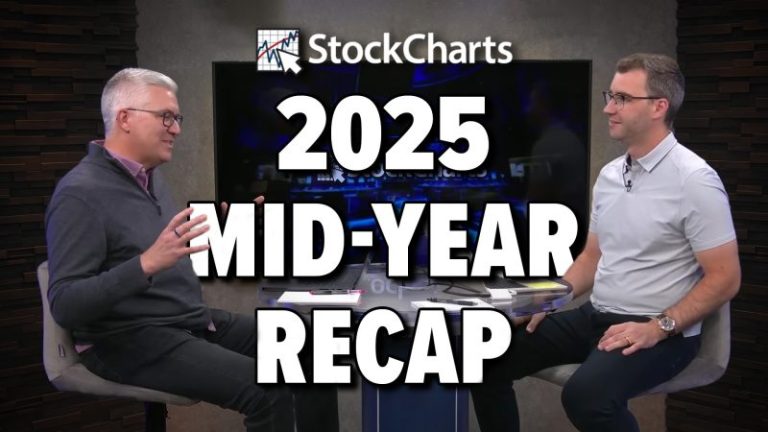
In this special mid-year recap, Grayson Roze sits down with David Keller, CMT, to show how disciplined routines, price-based signals, and a calm process helped them ride the whipsaw instead of getting tossed by it. You’ll see what really happened under the surface, how investor psychology drove the swings, and the exact StockCharts tools they leaned on to stay objective. 

If you’re focused on protecting capital, generating income, and sleeping well at night while still capturing the upside, this is a must-watch. Discover which charts deserve your attention now, what to ignore, and how to prep for the back half of 2025. 

This video premiered on July 23, 2025. Click on the above image to watch on our dedicated Grayson Roze page on StockCharts TV.

You can view previously recorded videos from Grayson at this link.

Here are some charts that reflect our areas of focus this week at


XLU Leads with New High

Even though the Utilities SPDR (XLU) cannot keep pace with the Technology SPDR (XLK) and Communication Services SPDR (XLC), it is in a leading uptrend. XLU formed a cup-with-handle from November to July and broke to new highs the last two weeks. ETFs hitting new highs are in strong uptrends and should be on our radar.


Metal Mania in 2025

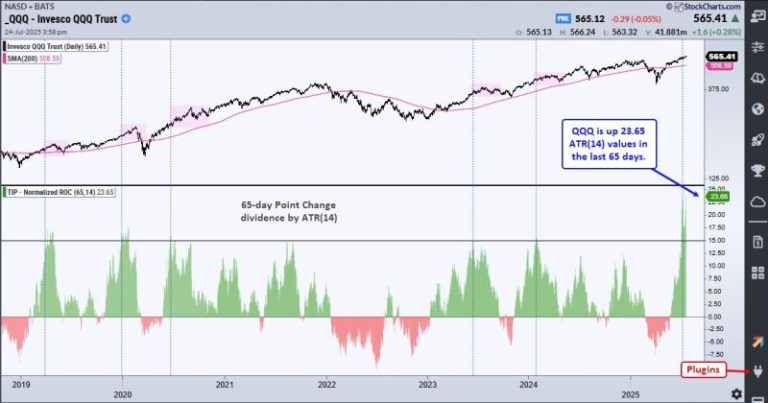
In a tribute to Ozzy, metals are leading the way higher in 2025. The PerfChart below shows year-to-date performance for the continuous futures for 12 commodities. Copper, Platinum and Palladium are up more than 45% year-to-date, while Gold is up 28.38% and Silver is up 35.30%. QQQ is up 10.52% year-to-date, but lagging these metals. The other commodities are mixed.


Multi-Year Highs for Silver and Copper

The next chart shows 11 year bar charts for five metals. Gold broke out in early 2024 and led the metals move with an advance the last 21 months. Silver and copper broke out to multi-year highs. Platinum broke above its 2021 high and Palladium got in the action with an 18 month high. There is a clear message here: metals are moving higher and leading as a group.  


Home Construction Hits Moment of Truth

The Home Construction ETF (ITB) hit its moment of truth as it rose to its falling 40-week SMA. Notice that ITB failed just below this moving average in August 2023. During the 2023-2024 uptrend, the 40-week SMA was more friendly as ITB reversed near this level in October 2023 and June 2024. ITB surged to the falling 40-week SMA in July, but the long-term trend is down and this area could be its nemesis.

Thanks for Tuning in!

See TrendInvestorPro.com for more


The S&P 500 ($SPX) just logged its fifth straight trading box breakout, which means that, of the five trading ranges the index has experienced since the April lows, all have been resolved to the upside.

How much longer can this last? That’s been the biggest question since the massive April 9 rally. Instead of assuming the market is due to roll over, it’s been more productive to track price action and watch for potential changes along the way. So far, drawdowns have been minimal, and breakouts keep occurring. Nothing in the price action hints at a lasting change — yet.

While some are calling this rally “historic,” we have a recent precedent. Recall that from late 2023 through early 2024, the index had a strong start and gave way to a consistent, steady trend.

From late October 2023 through March 2024, the S&P 500 logged seven consecutive trading box breakouts. That streak finally paused with a pullback from late March to early April, which, as we now know, was only a temporary hiccup. Once the bid returned, the S&P 500 went right back to carving new boxes and climbing higher.

New 52-Week Highs Finally Picking Up

If there’s been one gripe about this rally, it’s that the number of new highs within the index has lagged. As we’ve discussed before, among all the internal breadth indicators available, new highs almost always lag — that’s normal. What we really want to see is whether the number of new highs begins to exceed prior peaks as the market continues to rise, which it has, as shown by the blue line in the chart below.

As of Wednesday’s close, 100 S&P 500 stocks were either at new 52-week highs or within 3% of them. That’s a strong base. We expect this number to continue rising as the market climbs, especially if positive earnings reactions persist across sectors.

Even when we get that first day with 100+ S&P 500 stocks making new 52-week highs, though, it might not be the best time to initiate new longs.

The above chart shows that much needs to align for that many stocks to peak in unison, which has historically led to at least a short-term consolidation, if not deeper pullbacks — as highlighted in yellow. Every time is different, of course, but this is something to keep an eye on in the coming weeks.

Trend Check: GoNoGo Still “Go”

The GoNoGo Trend remains in bullish mode, with the recent countertrend signals having yet to trigger a greater pullback.

Active Bullish Patterns

We still have two live bullish upside targets of 6,555 and 6,745, which could be with us for a while going forward. For the S&P 500 to get there, it will need to form new, smaller versions of the trading boxes.

Failed Bearish Patterns

In the chart below, you can view a rising wedge pattern on the recent price action, the third since April. The prior two wedges broke down briefly and did not lead to a major downturn. The largest pullbacks in each case occurred after the S&P 500 dipped below the lower trendline of the pattern.

The deepest drawdown so far is 3.5%, which is not exactly a game-changer. Without downside follow-through, a classic bearish pattern simply can’t be formed, let alone be broken down from.

We’ll continue to monitor these formations as they develop because, at some point, that will change.

Is the market’s next surge already underway? Find out with Tom Bowley’s breakdown of where the money is flowing now and how you can get in front of it.

In this video, Tom covers key moves in the major indexes, revealing strength in transports, small caps, and home construction. He identifies industry rotation signals, which are pointing to aluminum, recreational products, and furnishings. Tom then demonstrates how to use StockCharts’ tools to scan for momentum stocks in emerging leadership groups — see why SGI tops Tom’s list. He ends with a discussion of post-earnings reactions from major names like GOOGL, TSLA, IBM, and LVS. 

And, of course, Tom wraps every idea with clear chart setups you can act on today. 

This video premiered on July 24, 2025. Click this link to watch on Tom’s dedicated page.

Missed a session? Archived videos from Tom are available at this link.

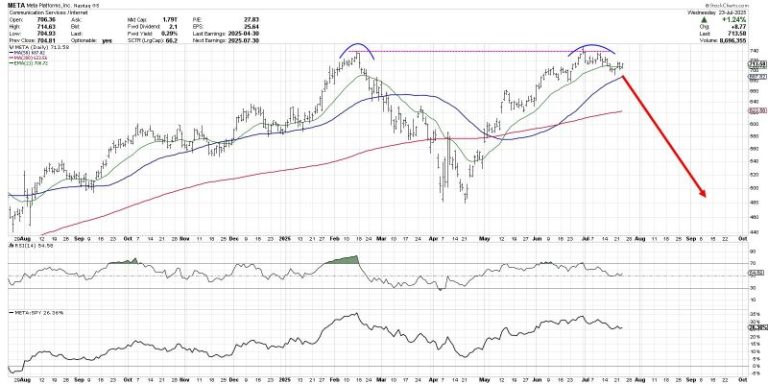
The chart of Meta Platforms, Inc. (META) has completed a roundtrip from the February high around $740 to the April low at $480 and all the way back again.  Over the last couple weeks, META has now pulled back from its retest of all-time highs, leaving investors to wonder what may come next.

Is this the beginning of a new downtrend phase for META?  Or just a brief pullback before a new uptrend phase propels META to new all-time highs?

Today we’ll look at two potential scenarios, including the double top pattern and the cup and handle pattern, and share which technical indicators and approaches could help us determine which path plays out into August.

The double top scenario basically means that the late July retest of the previous all-time high was the end of the recent uptrend phase.  The double top pattern is literally when a major resistance level is set and then retested.  The implication is that a lack of willing buyers means the uptrend is exhausted, and there is nowhere to go but down.

While the 21-day exponential moving average is currently in play for META, I would say that a break below the 50-day moving average could confirm this as the correct scenario.  If that smoothing mechanism does not hold, then the price action would imply less of a pullback and more like the beginning of a real distribution phase.

What is META pulls back but then resumes an uptrend phase, leading META to another new all-time high?  That would result in a confirmed cup and handle pattern, created by a large rounded bottoming pattern followed by a brief pullback.  The key to this pattern is the “rim” of the cup, which sits right at $740 for META.

Given the pullback META has demonstrated so far in July, I would say that a break above the $740 level would basically confirm a bullish cup and handle pattern.  That would suggest much more upside potential for META, as the stock would literally go into previously uncharted territory.

So how can we determine which scenario is more likely to play out?  This is where we need to incorporate more technical indicators into the discussion, as a way to further validate and confirm our investment thesis.

Just to review, I think a break above $740 would confirm a bullish cup and handle pattern.  I would also say that a break below the $680 level, which would represent a move below the 50-day moving average as well as the June swing lows, would basically confirm a bearish double top pattern.

We can also use the Relative Strength Index (RSI) to help determine whether META remains in a bullish trend phase.  During bull phases, the RSI rarely gets below 40, because buyers usually step in to “buy the dips” and keep the momentum fairly constructive.  So if the price would break down, and the RSI would not hold that crucial 40 level, that could mean a bearish outlook is warranted.

Finally, we can use volume-based indicators to assess whether moves in the price are supported by stronger volume readings.  Here I’ve included the Accumulation/Distribution Line, which tracks the trend in daily volume readings over time.  We can see that the high in July resulted in a divergence, as the A/D line was trending lower.  If the A/D line would break below its June and July lows, marked by a dashed red line, that would represent a bearish volume reading for META.

Technical analysis is less about predicting the future, and more about determining the most probable scenarios based on our analysis of trend, momentum, and volume.  I hope this discussion shows how the outlook for META can be easily determined and tracked using the best practices of technical analysis!

RR#6,

Dave

PS- Ready to upgrade your investment process?  Check out my free behavioral investing course!

David Keller, CMT

President and Chief Strategist

Sierra Alpha Research LLC

marketmisbehavior.com

https://www.youtube.com/c/MarketMisbehavior

Disclaimer: This blog is for educational purposes only and should not be construed as financial advice.  The ideas and strategies should never be used without first assessing your own personal and financial situation, or without consulting a financial professional.  

The author does not have a position in mentioned securities at the time of publication.    Any opinions expressed herein are solely those of the author and do not in any way represent the views or opinions of any other person or entity.

(TheNewswire)

Brossard, Quebec TheNewswire – le 12 mars 2026 CORPORATION Charbone (TSXV: CH,OTC:CHHYF; OTCQB: CHHYF; FSE: K47) (« Charbone » ou la « Société »), un producteur et distributeur nord-américain spécialisé dans l’hydrogène propre Ultra Haute Pureté (« UHP ») et les gaz industriels stratégiques, est heureuse d’annoncer sa participation à la conférence Hydrogen East du 13 avril 2026, ainsi que le développement d’un hub d’approvisionnement dédié à l’hydrogène UHP et aux gaz de spécialité stratégiques dans le marché du Canada Atlantique (« Hub Atlantique »).

Cette initiative marque une nouvelle étape dans la stratégie de déploiement de Charbone visant à établir un réseau intégré de hubs de production, stockage et distribution d’hydrogène et de gaz industriels stratégiques en Amérique du Nord.

Le futur Hub Atlantique qui sera géré par sa filiale Charbone Nouvelle-Écosse Inc. et opérationnel d’ici juin 2026, servira d’installation physique dédiée au stockage local et à la distribution régionale, permettant d’assurer un approvisionnement fiable et flexible en hydrogène pour une variété d’utilisateurs industriels exigeants, incluant les secteurs de la défense, de la fabrication avancée, de la mobilité et des infrastructures énergétiques.

Charbone est active dans la région de l’Atlantique depuis plus de trois (3) années et a développé une connaissance approfondie des marchés de la Nouvelle-Écosse, du Nouveau-Brunswick et de l’Île-du-Prince-Édouard, tout en travaillant sur différentes initiatives avec des clients et partenaires potentiels d’envergure, notamment dans les domaines suivants :

  • infrastructures portuaires 

  • chantiers navals et installations de la Marine canadienne 

  • chaîne d’approvisionnement de composantes automobiles 

  • entreprises de services publics et énergétiques 

  • entreprises de recherche et développement 

  • solutions de transport avancées à éro émission 

Ce modèle « hub-and-spoke » constitue un pilier de la stratégie de Charbone visant à déployer progressivement un réseau évolutif de hubs d’approvisionnement en hydrogène et en gaz industriels stratégiques à travers le Canada et les États-Unis, permettant de soutenir les marchés régionaux grâce à des capacités locales de stockage, de logistique et de distribution.

« La région du Canada Atlantique représente un marché stratégique pour Charbone, notamment en raison de la présence d’infrastructures de grandes qualités, d’utilisateurs industriels d’envergures et d’initiatives de transition énergétique, » a déclaré Dave B. Gagnon, PDG de Charbone. La Société prévoit que ce hub jouera un rôle structurant dans le développement de sa future plateforme logistique nord-américaine de l’hydrogène. »

Pour plus de détails sur la Conférence Hydrogen East, veuillez cliquer sur le lien ci-bas :

À propos de CORPORATION Charbone

Charbone est un développeur et producteur d’hydrogène propre Ultra Haute Pureté (UHP) doté d’une plateforme de distribution de gaz industriels en pleine expansion. Grâce à une approche modulaire, Charbone se concentre sur le développement d’un réseau d’usines de production d’hydrogène propre en Amérique du Nord et sur certains marchés à l’étranger, en commençant par son projet phare de Sorel-Tracy au Québec. Le modèle intégré de l’entreprise réduit les risques, améliore l’évolutivité et permet de diversifier ses sources de revenus grâce à des partenariats dans le domaine de l’hélium et d’autres gaz de spécialités. Charbone s’engage à soutenir la transition mondiale vers une économie bas carbone en fournissant des solutions d’hydrogène propre et de gaz de spécialités accessibles et décentralisées, tout en soutenant les clients industriels mal desservis en gaz et en accélérant la transition vers une énergie propre locale. Charbone est coté sur la bourse de croissance TSX (TSXV: CH,OTC:CHHYF); sur les marchés OTC (OTCQB: CHHYF); et à la Bourse de Francfort (FSE: K47). Pour plus d’informations, veuillez visiter www.charbone.com.

Énoncés prospectifs

Le présent communiqué de presse contient des énoncés qui constituent de « l’information prospective » au sens des lois canadiennes sur les valeurs mobilières (« déclarations prospectives »). Ces déclarations prospectives sont souvent identifiées par des mots tels que « a l’intention », « anticipe », « s’attend à », « croit », « planifie », « probable », ou des mots similaires. Les déclarations prospectives reflètent les attentes, estimations ou projections respectives de la direction de Charbone concernant les résultats ou événements futurs, sur la base des opinions, hypothèses et estimations considérées comme raisonnables par la direction à la date à laquelle les déclarations sont faites. Bien que Charbone estime que les attentes exprimées dans les déclarations prospectives sont raisonnables, les déclarations prospectives comportent des risques et des incertitudes, et il ne faut pas se fier indûment aux déclarations prospectives, car des facteurs inconnus ou imprévisibles pourraient faire en sorte que les résultats réels soient sensiblement différents de ceux exprimés dans les déclarations prospectives. Des risques et des incertitudes liés aux activités de Charbone peuvent avoir une incidence sur les déclarations prospectives. Ces risques, incertitudes et hypothèses comprennent, sans s’y limiter, ceux décrits à la rubrique « Facteurs de risque » dans le rapport de gestion de la Société pour la période terminée le 30 septembre 2025, qui peut être consultée sur SEDAR+ à l’adresse www.sedarplus.ca; ils pourraient faire en sorte que les événements ou les résultats réels diffèrent sensiblement de ceux prévus dans les déclarations prospectives.

Sauf si les lois sur les valeurs mobilières applicables l’exigent, Charbone ne s’engage pas à mettre à jour ni à réviser les déclarations prospectives.

Ni la Bourse de croissance TSX ni son fournisseur de services de réglementation (tel que ce terme est défini dans les politiques de la Bourse de croissance TSX) n’acceptent de responsabilité quant à la pertinence ou à l’exactitude du présent communiqué.


Contact Corporation Charbone

Téléphone: +1 450 678 7171

Courriel: ir@Charbone.com

Benoit Veilleux

Chef de la direction financière et secrétaire corporatif


Copyright (c) 2026 TheNewswire – All rights reserved.

News Provided by TheNewsWire via QuoteMedia

This post appeared first on investingnews.com